Farmer's Guide to EQIP: Funding for Farm Conservation
Overview
The Environmental Quality Incentives Program (EQIP) is one of the USDA's most widely used conservation funding programs, providing cost-share payments to farmers and ranchers who implement approved conservation practices on their land. Administered by the Natural Resources Conservation Service (NRCS), EQIP supports a broad range of projects aimed at improving soil health, water quality, air quality, and wildlife habitat. The program is funded through the federal farm bill, with approximately $1 billion allocated annually. Both beginning and experienced producers may be eligible, with historically underserved farmers receiving enhanced cost-share rates. This guide answers the most common questions about how EQIP works, who qualifies, what projects are covered, and how to submit a competitive application. For those who would like to learn more about USDA Farm Service Agency Programs, they should visit the FSA Educational Hub.
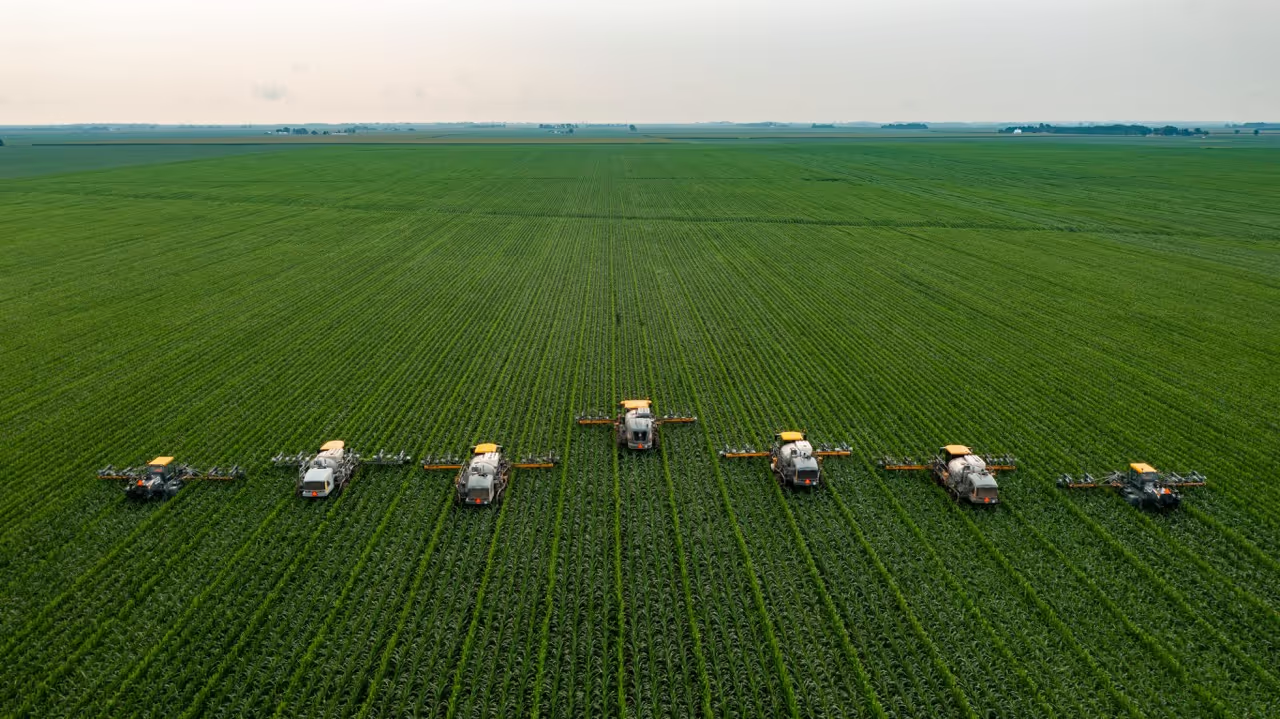
The United States Department of Agriculture (USDA) has made one thing clear in recent years: one of their main priorities is addressing natural resource concerns by promoting sustainability practices in agriculture. That’s good news for agricultural producers who may want to implement conservation practices on their farmland, rangeland or pastureland. Not to mention, adopting new practices can boost profitability, too.
Let’s take a look at one of the USDA’s most popular funding programs. In this article we’ll cover these questions:
- What is EQIP? How does the EQIP program work? (technical and financial assistance, payments rates-cost share)
- What are the benefits of EQIP?
- Who qualifies for EQIP financial assistance? What practices could be covered by
- Application tips: How can you make yourself a strong candidate (management plan,
- EQIP Deadlines and Application Timelines
- What happens once you win an EQIP grant
Did you know that FarmRaise helps farmers easily apply for EQIP?
Be more competitive for funding opportunities by tracking your farm expenses. Sign up for FarmRaise Tracks to get started! This tool also helps you keep great financial records for reporting on your EQIP grant.
What is the Environmental Quality Incentives Program?
EQIP is a farm funding program that enables producers to adopt conservation practices on the farm or ranch. It’s a national program that’s administered at the state level but the budget is set by the farm bill every five years. The U.S. Department of Agriculture (USDA) sets aside one billion dollars of its farm bill budget for EQIP each year, with the average farmer or rancher netting $30,000 from an annual EQIP contract.
$30,000 sounds like a nice chunk of change to help you plant cover crops, try out rotational grazing or adopt another conservation practice. If you’re a farmer or rancher looking for funding related to farm conservation, soil health, water quality or air quality initiative, EQIP might be right for you! But before you get started applying for farm funding, there are a few things you should keep in mind.
EQIP is offered through a USDA office called NRCS which stands for “Natural Resource Conservation Service.” NRCS offers assistance to producers and sets out to conserve natural resources on private lands.
How Does EQIP Work: Farm Cost-Share Program
- EQIP is a cost share program run by the NRCS
- Both you and the gov contribute funds
EQIP awards are structured as cost-share contracts, where the NRCS will reimburse participating producers for 75 percent of the implemented practice cost. That means you’d have to have some capital up front.
But if you’re a beginning farmer, you can also apply to receive an advance of half of the funding for the project or practice. Beginning and underserved producers may receive up to 90 percent cost-share, rather than the standard 75 percent rate.
How Much Money Can You Get With EQIP?
- In short, 50 - 90% of the project depending on your eligibility
EQIP assistance can vary in dollar amounts based on your proposed practice and your state, but generally the amount is up to 75 percent of the cost of your project. If you’re a historically underserved producer, you can receive up to 90 percent, with 50 percent of that funding upfront. The average producer may secure $30,000 in funding.
Benefits of EQIP
- EQIP can benefit the environment, your yields and your wallet
Environmental Benefits
The EQIP program was designed to encourage producers to take up the battle against climate change and integrate conservation into their operation. Every EQIP project is approved because of its potential to address natural resources concerns. While it’s tough to calculate the effects the program has had on the environment thus far, the intent of the program is to:
- Improve soil health
- Improve water and air quality
- Create healthy habitats for wildlife and pollinators
- Mitigate the effect of extreme weather
- Much more
The agricultural sector is often cited as a major contributor to greenhouse gas emission and negative environmental effects. EQIP was establish to address and reserve these effects.
Efficiency Benefits
The projects EQIP covers can help farmers deal with soil erosion, improve irrigation efficiency, animal feeding operations, water resources, quality of surface water and crop rotation practices.
Profitability
EQIP can be a great option for the limited resource farmer or rancher. Remember: EQIP is a cost-share program. That means a producer will have to put up a share of the project’s cost to fulfill the program requirements. However, it can be an excellent investment in a beginning operation. By instilling conservation practices in an operation in its beginning stages, a producer could save significantly from reduced input costs, energy efficiency and added-value to your produce.
Operational Benefits
EQIP requires you to come up with a plan of operations and conservation plan so the NRCS knows exactly what your plan for the fund is.
In other words, EQIP can lead to a more cost-efficient, environmentally-friendly farm.

Who Qualifies for EQIP Financial Assistance?
- Eligible land though both urban and rural farms may qualify
- Nonindustrial private forest land
- Historically underserved and beginning farmers
As important as who can qualify for EQIP is what land can qualify for EQIP. Land eligibility is defined as cropland, grassland, rangeland, pastureland, confined livestock feeding operations, and any other nonindustrial private forestland. If your land doesn’t quite fit into those definitions, don’t give up yet because there’s another category you may fit under: agricultural lands that have the capability to address resource concerns. That could potentially include watershed land or your community garden. It all depends on your resources and intentions which we’ll highlight later.
Based on that definition, most farmers and ranchers are eligible. But some producers will receive priority consideration when they apply. Those producers are what the USDA calls “historically underserved” and it includes farmers who face social or economic disadvantages. If you want to learn more about if you qualify, read our post about funding for underserved producers.
Farm Projects Eligible for EQIP Funding
- Have a specific project in mind
- Know the most common eligible projects
You need to have a specific farm project in mind to get EQIP funds, and it will need to address a resource concern (something related to soil, water, air quality or animal health/husbandry) for you to be a competitive EQIP applicant.
Each EQIP contract is for a specific practice or project that must fit the NRCS practice standards. Your state NRCS office will have a list of all applicable practices and their corresponding standards. FarmRaise can help you identify which practices are the best fit for your operation, so that you can be more competitive when you submit your paperwork.
You’ll also want to keep cost-effectiveness in mind. Does the proposed cost of your project appropriately correspond to the conservation benefits you anticipate as a result? A cost-effective proposal could be a factor that makes you a more attractive EQIP candidate.
Here are some of the most common EQIP projects and practices:
- Installing fencing to support rotational grazing or prescribed grazing practices
- Adding high tunnels
- Transitioning to organic
- Nutrient management planning
- Improving irrigation and livestock watering systems
- Transitioning to low or no-till management
- Pest management practices
- Adoption of natural fertilizers, herbicides and pesticides
At FarmRaise, we’ve heard many farmers we serve offer this piece of feedback: NRCS practice standards can be limiting. For example, if you want to plant a cover crop, the NRCS may be prescriptive in which cover crop you can plant and when.
Don’t let this be a barrier to participating in the program. It’s nothing that can’t be fixed by a conversation with your local NRCS representative.
Application Tips: How to Be a Strong EQIP Candidate
- Talk to your field office and ask about their priorities for the year
- Create a conversation plan
EQIP is competitive. Only about one in three applicants will receive funding, and that’s not because they aren’t worth funding.
The most competitive applications address the NRCS’s existing resource concerns on the land.
EQIP grants are ranked and awarded based on resource concerns. State conservationists from your state technical committee decide what your region’s priorities are each fiscal year. That’s why the strongest applicants are those that already have a solid idea for a project that is also in line with the priority resource concerns of the state. If you’re looking for guidance on what those concerns are in your area, talk with an NRCS employee at your local office.
You’ll Need a Farm Number
You need up-to-date Farm Service Agency (FSA) records to complete an EQIP application.
EQIP requires you to fill out several different forms about your farm income status, your land’s highly erodible and wetland status and your farm’s structure, in addition to your conservation program application. One critical piece of the application is a farm number which you’ll receive when you set up FSA records. Learn more about what a farm number is and how to get one.
If you’re ready to apply for EQIP, contact your local USDA service center and ask for an EQIP application. First, take two minutes right now to check if you’re eligible for EQIP before you begin applying to save yourself some of the headache.
To establish an FSA Farm Number you can head to the FSA Educational Hub to get started.
EQIP Application Process and Deadlines
- Apply anytime
- May take 3 to 6 months
- Applications are reviewed once or twice each year depending on your state
- Sign up for EQIP alerts
There’s no set deadline for everyone in the nation, but applications are batched for consideration each year. If you want a shot at EQIP, you need to apply before the batching deadline for that year, which usually ranges from November to February, depending on your state.
Be prepared for a long application-to-award timeline.
It takes about three to six months after applying for EQIP to receive an award notification.
The NRCS typically makes decisions about which projects to fund within three months of each batching deadline. Let’s say your state’s batching deadline for EQIP is January. If you apply early in December, you may have to wait at least four months before hearing back about your proposal.
Keep in mind that NRCS, like any government program, can face delays caused by federal and state agency dynamics, lack of staff, whether emergencies or global pandemics.
EQIP Program Expectations
- You’ll receive a visit from a USDA-NRCS representative.
There are three scenarios when a USDA-NRCS representative might come to visit your farm. Regardless, they are required to give you advance notice before they come out.
- When you initially apply for EQIP - The NRCS will send a representative to meet you and walk the land. They’ll want to know where you plan to place a specific project or practice.
- After you install the practice - An NRCS representative will come to observe and verify that the installation is complete and in line with the contract specifications.
- Random spot check - It’s rare, but a representative might come check on how your project is unfolding. Again, advance notice is required.

If you’re ready to apply for EQIP, contact your local USDA service center and ask for an EQIP application. First, take two minutes right now to check if you’re eligible for EQIP before you begin applying to save yourself some of the headache.
EQIP applications can be time consuming. FarmRaise has streamlined those EQIP forms into one, simple common application that takes a fraction of the time it takes to complete a traditional application. You can then submit your application to the right stakeholders at your county office. You can apply, if you’re eligible, through the FarmRaise platform. If you’re ready to start applying for EQIP, you can start today from the comfort of your home or office. Keep Rising!
Ready to try FarmRaise for free?
Start your free 7-day trial of FarmRaise Premium today.
Ready to try FarmRaise for free?
Start your free 7-day trial of FarmRaise Premium today.
Ready to try FarmRaise for free?
Start your free 7-day trial of FarmRaise Premium today.
See how how easy FarmRaise makes Taxes & Schedule F!
Ready to try FarmRaise for free?
Start your free 7-day trial of FarmRaise Premium today.
Ready to streamline your program management?
See how FarmRaise can simplify farmer-facing program management for your organization.
Ready to simplify payroll on your farm?
See if FarmRaise Payroll is right for you!
FAQs
What is the Environmental Quality Incentives Program (EQIP) and how is it funded?
EQIP is a federal conservation cost-share program administered by the USDA's Natural Resources Conservation Service (NRCS) that helps agricultural producers adopt conservation practices on their farms, ranches, and pastureland. The program is funded through the federal farm bill, which is reauthorized approximately every five years, and the USDA sets aside roughly $1 billion annually for EQIP awards. Unlike a traditional grant, EQIP operates as a cost-share contract, meaning both the producer and the federal government contribute to the cost of the approved project. The average EQIP contract nets a producer around $30,000, though amounts vary depending on the practice, the state, and the producer's eligibility status. EQIP is designed to address natural resource concerns such as soil erosion, water quality degradation, and air quality issues while also helping producers improve the long-term efficiency and profitability of their operations. Producers interested in conservation funding for their farm or ranch should start by contacting their local USDA service center to learn about state-specific priorities and available practices.
How does EQIP cost-share work and how much funding can a producer receive?
EQIP is structured as a cost-share program, which means the NRCS reimburses producers for a portion of the cost of implementing an approved conservation practice rather than covering the full expense upfront. The standard reimbursement rate is 75 percent of the total practice cost, meaning producers are responsible for covering the remaining 25 percent out of pocket before receiving reimbursement. Beginning farmers and historically underserved producers are eligible for an enhanced cost-share rate of up to 90 percent, and they may also apply to receive an advance of 50 percent of their funding before the project is complete to reduce upfront financial burden. The total dollar amount a producer can receive depends on their proposed practice and their state's payment schedule, but the average award sits around $30,000 per contract. Producers should view EQIP as an investment: while some upfront capital is required, the long-term savings from reduced input costs, improved energy efficiency, and increased produce value can significantly outweigh the initial cost-share contribution. FarmRaise Tracks can help producers maintain the financial records needed to document project costs and meet EQIP reporting requirements throughout the contract period. The FSA Educational Hub also houses a Record Keeping Toolbox to assist producers in maintaining records.
What are the environmental and operational benefits of participating in EQIP?
EQIP was specifically designed to help the agricultural sector reduce its environmental footprint while also making individual farming operations more efficient and productive. On the environmental side, approved EQIP projects are selected for their potential to improve soil health, enhance water and air quality, create wildlife and pollinator habitat, and mitigate the impacts of extreme weather events. On the operational side, EQIP-funded practices can help producers address soil erosion, improve irrigation efficiency, upgrade livestock watering systems, and transition to lower-input management approaches such as reduced tillage or organic production. Financially, EQIP can be particularly valuable for beginning or limited-resource producers who want to build conservation infrastructure early in their operation, since the long-term input cost reductions can more than offset the required cost-share contribution. The program also requires producers to develop a conservation plan and operations plan, which encourages more intentional and cost-efficient farm management overall. Producers who have transitioned or are considering a transition to organic production can also use EQIP funds to support that process, making it a versatile tool for a wide range of farm goals.
Who is eligible for EQIP financial assistance and what land qualifies?
Eligibility for EQIP extends to a broad range of agricultural producers, including farmers, ranchers, and forest landowners operating on private or tribal land. Eligible land types include cropland, grassland, rangeland, pastureland, confined livestock feeding operations, nonindustrial private forestland, and agricultural lands with the demonstrated capability to address resource concerns, which can in some cases include watershed land or community gardens. Most farmers and ranchers will meet the basic eligibility requirements, but certain producers receive priority consideration during the ranking process, particularly those the USDA designates as "historically underserved," which includes producers facing social or economic disadvantages as well as beginning farmers. Both urban and rural farming operations may qualify depending on the land type and the proposed practice. Producers who are unsure whether their land or operation qualifies should contact their local NRCS office for guidance before beginning the application process. Having accurate and up-to-date FSA records, including a valid farm number, is also a prerequisite for submitting a complete EQIP application. To learn more about FSA records, visit the FSA Educational Hub.
What types of farm projects and practices are eligible for EQIP funding?
EQIP funds a wide range of conservation practices, but every approved project must address a specific natural resource concern related to soil, water, air quality, or animal health and husbandry. Producers need to identify a specific project tied to a NRCS practice standard, and each state's NRCS office maintains a list of eligible practices and their corresponding technical specifications. Some of the most commonly funded EQIP practices include installing fencing to support rotational or prescribed grazing, adding high tunnels, transitioning to organic production, implementing nutrient management plans, upgrading irrigation and livestock watering systems, transitioning to low or no-till management, adopting pest management practices, and switching to natural fertilizers, herbicides, or pesticides. Producers should also consider cost-effectiveness when selecting a practice, since a proposal that demonstrates a clear relationship between project cost and anticipated conservation benefit tends to be more competitive in the ranking process. It is worth noting that NRCS practice standards can be prescriptive, for example specifying which cover crop varieties are acceptable or when they may be planted, so producers should discuss their specific plans with a local NRCS representative.
How do you apply for EQIP and what should producers expect from the process?
There is no single national application deadline for EQIP; instead, applications are batched for review once or twice per year depending on the state, with most batching deadlines falling between November and February. Producers should apply as early as possible before their state's batching deadline. The application requires producers to submit several forms covering farm income status, highly erodible land and wetland determinations, farm structure, and the conservation program application itself, and a valid FSA farm number is required to complete the process. Once submitted, producers should expect to wait approximately three to six months for an award notification, as the NRCS typically finalizes funding decisions within three months of each batching deadline. After applying, a NRCS representative will visit the farm to assess the land and discuss the proposed practice, and a follow-up site visit will occur after the practice is installed to verify that it meets contract specifications. FarmRaise has streamlined the EQIP application process into a simplified common application and works with producers to prioritize practices aligned with NRCS standards and submit paperwork to the appropriate county office, making it significantly easier to put together a competitive application.