What is the Value Added Producer Grant (VAPG) and How to Apply
Overview
The Value Added Producer Grant (VAPG) is a USDA program that awards up to $250,000 to agricultural producers for projects that add value to their farm operations through processing, marketing, and select operational expenses. Funded under the USDA's Local Agriculture Market Program (LAMP) and established by the 2018 Farm Bill, VAPG is a competitive grant with roughly 30 to 50 percent of applicants receiving awards each cycle. This guide covers eligibility requirements, the 1:1 matching requirement, what expenses qualify, and a step-by-step walkthrough of the application process to help producers submit the strongest possible proposal. Farmers looking to explore additional USDA funding options beyond VAPG can visit the FarmRaise FSA Educational Hub for program guides, eligibility breakdowns, and resources across FSA, NRCS, and other federal agencies. Whether you are a beginning farmer or an established operation looking to expand your market reach, understanding the VAPG program can open the door to meaningful farm revenue growth.
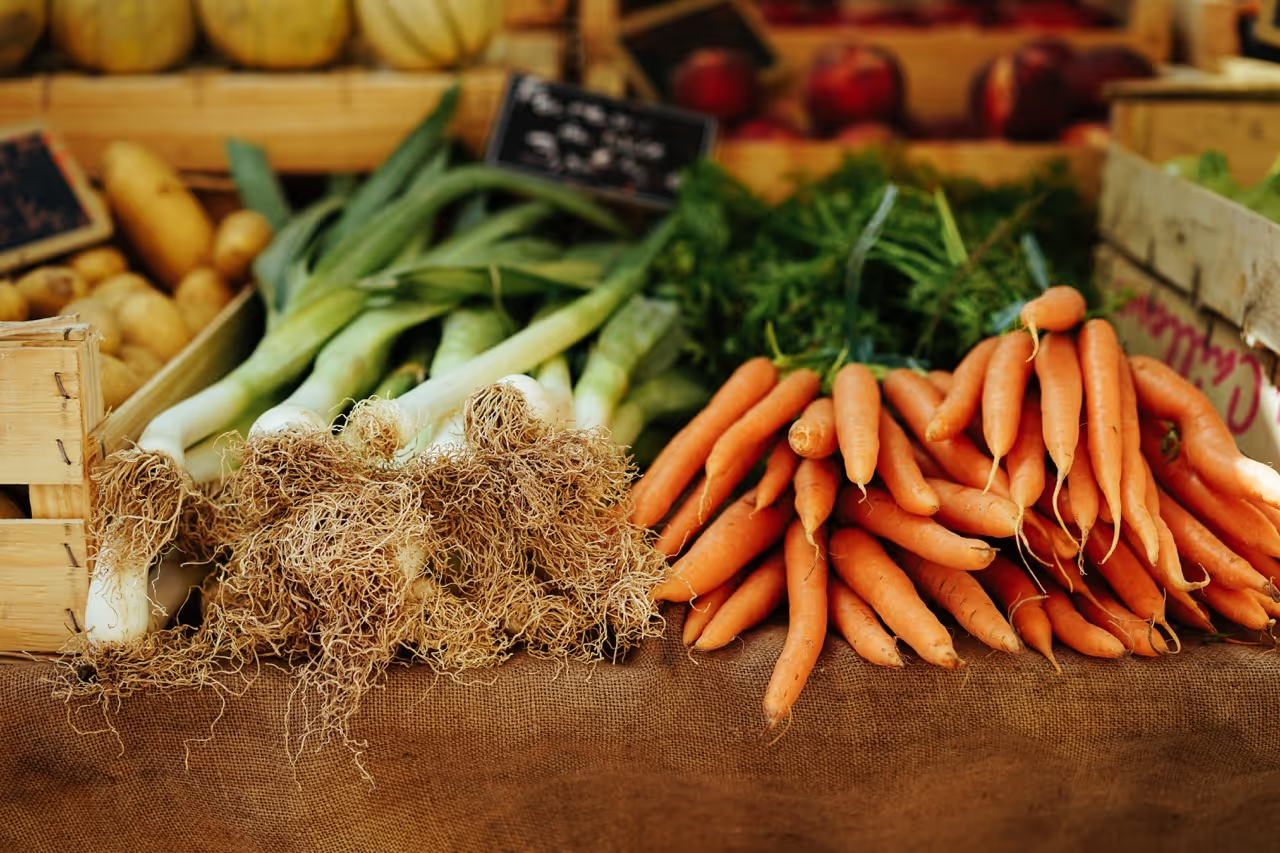
Many farmers message our FarmRaise team asking about the Value Added Producer Grant Program (VAPG), a U.S. Department of Agriculture (USDA) grant that awards funding for projects that “add value” to a farm operation in three categories: (1) processing costs (2) marketing and advertising expenses and (3) some inventory and salary expenses. To answer your questions, we spoke with professionals from the USDA Rural Development Office and an expert grant writer to get some insight into what makes a successful application.
In this post, we’ll cover:
- What the VAPG program is and how much funding you could receive
- Eligible projects
- The VAPG Matching Requirement
- Detailed VAPG application instructions
- Further resources
Before we dive in, if you're on the hunt for grants like the VAPG, know that our team at FarmRaise is eager to partner with you to find the best funding options for your farm.
Be more competitive for grants like the VAPG by tracking any expenses related to your farm today. Sign up for the FarmRaise Tracks app to get started!
An Overview of the VAPG Program
The VAPG program has approximately $20 to $25 million total funding available to producers each year, with between 30 and 50 percent of projects receiving awards. Individual projects can fund planning activities or working capital grants, with a maximum grant amount of $75,000 for planning grants and $250,000 for working capital grants.
Writing this grant can be a heavy lift, depending on whether you choose to apply for more than $50,000 or less than $50,000. This threshold is important because if you exceed $50,000 in your funding request, you must have an independent third party conduct a feasibility study for your project and include a business plan. If your request is $50,000 or below, you can skip that step and utilize a simplified application.
VAPG is a program under the USDA’s Local Agriculture Market Program (LAMP) which was created under the 2018 Farm Bill. Producers can find other LAMP grant funding opportunities as well as hundreds of other grants, loans and cost-shares in the FarmRaise Farm Funding Library. You can try the library for free and upgrade later if you want to take advantage of the library’s many features.
What Does “Value-Added” Mean?
What does “value-added” actually mean? For the purposes of this grant, the USDA defines “value-added” as projects or activities that fall in the five following categories:
- Change in physical state (turning berries into jam or tomatoes into sauce)
- Enhancing value by changing the way something is produced (think certifications that would help you capture a better price on the market, like organic certification)
- Physical segregation
- Local production (building a market for your existing farm goods or new products in your local area, increasing or scaling your local production)
- Farm or ranch-based renewable energy (using your farm products to create renewable energy — does NOT include solar/wind)
If you're interested in boosting your solar or wind energy efforts, learn more about the Rural Energy for America Program.
What Projects Does VAPG Fund?
The VAPG grant is oriented toward assisting with costs of most “post-harvest” activities like working capital expenses or marketing opportunities. For livestock producers, “post-harvest” is the point at which your animals have been slaughtered and have moved forward to the “cut and wrap” stage. Competitive and common uses for VAPG funds include:
- Designing a logo, website and/or labeling or paying a contractor to do so
- Paying the costs associated with changing the physical state of your agricultural good
- Developing signage for your farm stand
- Printing a custom farmers’ market tent
- Creating packaging for your product or your CSA box
- Coming up with a marketing plan
It does NOT cover:
- Production-related expenses that are pre-harvest (or pre-slaughter, for livestock)
- Equipment purchases
- Grant writing
While you can’t use the grant to purchase equipment yourself, you could use the grant to pay expenses associated with getting the job done another way. For example, do you need cold storage for your project to be feasible? Instead of purchasing a walk-in freezer for your property, you could use the grant funding to pay to rent cold storage elsewhere.
Think about how you might be able to pay contractors to get the work done, instead of buying your own equipment. This grant is all about giving you the means to start or expand a value-added activity for your farm, so non-equipment expenses are a great way to validate that your project has legs without the risk of purchasing an equipment asset up front.
What’s the Matching Requirement?
VAPG requires applicants to match the funds received 1:1. Matching funds means that you must be prepared to double — with your own resources — whatever the amount is you apply for.
This matching requirement can be daunting, but the good news is that you can use “in-kind” resources for up to half of your match. In-kind contributions are non-cash contributions you’ll bring to the table — like your own time, the raw materials/goods, or labor. So, if you’re applying for a $50,000 grant, you may want to illustrate that you’ll contribute the first $25,000 of your match as “in-kind” and the remaining $25,000 as cash.
In terms of the cash portion, you need to be able to show that you have access to the amount of cash required for the match. What counts as proof? A bank statement from your savings account or a note from your bank illustrating your line of credit will do.
Am I Eligible for VAPG Program Funding?
Your eligibility for VAPG is dependent upon whether:
- You own and produce at least 50% of the raw commodity used in the project
- You have at least one year’s history of sales from your operation
- You’re an independent farmer that has filed Schedule F taxes in the past, OR you apply as an agricultural producer group, cooperative or majority-controlled producer-based business venture
If you meet the above requirements, then your VAPG application success is really all about the project that you’re proposing. The grant is competitive, so you want to illustrate that your project can do a few key things for your farm. The project must increase your revenue, expand your customer base, and increase your income to be competitive.
Are Beginning Farmers Eligible for VAPG?
It can be hard to find the capital to get your farm off the ground. Thankfully the USDA might offer you priority if you’re:
- a beginning farmer or rancher
- a socially-disadvantaged farmer or rancher
- a small or medium-sized farm
- a ranch structured as a family farm
- a farmer or rancher cooperative
- proposing a mid-tier value chain
How Do I Apply for VAPG?
If you’re considering VAPG, eligible applicants should have a strong understanding of the project they have in mind.
Start by completing our VAPG Readiness Survey.
Taking the survey will ensure that your intended project is eligible for this program. When you finish the survey, you’ll see our recommendation for appropriate next steps for your operation, including how to get connected with a grant writer or find your own grant writer.
VAPG Application Process
The VAPG deadline is generally in the spring of each fiscal year. In 2023, electronic applications are due May 11th, 2023 and paper applications are due May 16th, 2023. We recommend getting started right away, as writing a VAPG application can take 60 to 100 hours to complete. Keep that in mind as you plan your grant application process.
The application is a multi-step process. You can complete it yourself or receive support from a mentor or grant writer. Here’s a quick review of the application’s major components:
Registration & Orientation
Step 1: Review the Application Toolkit
- If you’re planning to apply for the Working Capital Grant, download the Working Capital Grant toolkit document. If you’re applying for the Planning grant, download the Planning Grant application toolkit. Both toolkits should work whether you’re using a Microsoft Windows on your PC or Page on your Mac. These toolkits are from 2022 and are expected to be very similar to 2023’s. This year’s toolkits will be available here once released by the USDA, so check back for updates. You’ll need to download the toolkit
Step 2: Register with SAM.gov and UEI
- Since 2022, any entity applying for federal funds must have a Unique Entity Identifier (UEI) and valid registration on the System for Award Management (SAM). As an individual agricultural producer however, are not required to have a UEI or be registered in SAM. To register, visit SAM.gov. It can take 10-12 business days to receive a UEI, and can take longer the closer you are to the deadline - so we recommend prioritizing this step!
Step 3: Compile your farm business paperwork
- For entities, you’ll need:
- Completed Schedule F from the previous year
- Articles of Incorporation (C Corp) or Operating Agreement (LLC)
- Bylaws
- Certificate of Good Standing
- Individual CV/Resume for all involved parties
- For individuals, you’ll need:
- IRS tax form from the previous year, showing farm income
- Individual CV/Resume
- If you are a Tribe entity, visit Appendix A of the Application Toolkit for the required documents.
- Complete any relevant documents for special categories as needed, found in Appendix E of the Application Toolkit.
Step 4: Connect with your local Rural Development Office
- After finding your local RD’s contact information, give them a call to let them know about your intended application. Ask if they have any recommendations or resources to support you. Many offices will review your draft materials prior to submission.
Project Planning, Market Analysis & Community Support
We recommend completing the following sections in a separate document, instead of drafting directly into your application.
Step 5: Market Research
- At this point, you should have a tangible and concise way to describe the project you want to undertake, now you should build the market research and sales projections to support the outcomes the project will drive. Third party research, customer data, and local market research are great data to support any assumptions or claims in your project.
- Begin compiling your resources in one place, and consider how they will fit into the narrative portion of your application. It is helpful to read the questions in your application toolkit ahead of your research.
Step 6: Sales Analysis & Predictions
- Estimate profit and revenue: A core tenant of a successful application is its ability to appropriately predict the increase in profit or revenue that the project will provide to your farm business.
- Perform sales analysis: Providing recent sales data from the last 1 to 5 years, analyze your volume of sales, cost and revenue for farm products, customer base and local markets.
- Build sales projections: Looking forward, how will the project affect future business. Estimate your increases in revenue, profit and other relevant metrics for growth. It is important to have appropriate predictions, based on market research and previous sales.
Step 7: Letters of Support
- To reinforce your market research and sales data, letters of support from your community are vital. VAPG outlines three types of sources you can use for Letters of Support:
- Independent producers
- Customers
- Third parties (i.e. Farmers’ Market coordinator, local food council, etc.)
- Give your supporters a template to work from to reduce the barrier of them having to draft something from scratch. To make your job easier, we’ve put together a VAPG Letter of Support template for you. We recommend being very clear about when you need the signed letter, offering a deadline weeks prior to your estimated submission date.

Timeline & Budgeting
The budgeting component of this grant is very important. It outlines how your grant funding will be used in a detailed and organized manner, driving the outcomes of your project.
Step 8: Budget
- Before building the budget in your Application Toolkit, we recommend starting with Excel or Google Sheets to assist in the organization, formatting and calculations.
- Begin by listing out all the costs by name associated with the project, not your entire farm. Obtain quotes for costs you plan to make by calling vendors and collecting digital or physical records.
Step 9: Project Timeline
- Once you’ve completed your budget, you’ll move on to the project timeline. The timeline is separated by bucket tasks (such as “purchase new packaging” or “build digital presence and website”) composed of individual activities. Each activity will include a projected start and end date as well as the costs, broken down by where the funding for each cost is coming from (VAPG funds, in-kind matching funds and cash matching funds).
- When you have finalized your budget and project timeline, move them into your Application Toolkit. We recommend contact your local Rural Development Office to review your budget and project timeline once complete.
Composing Your Narrative & Submission
The bulk of the narrative portion is found in Sections 5 and 6 of your application toolkit, however you must complete Sections 1-4, 7 and the Appendices to the full extent. Ensure that each appropriate checkbox is filled, and that every single prompt is addressed.
Sections 1-4 & 7:
- Section 1-4 detail your eligibility, qualifications and brief summaries of your project.
- Section 7 requires verification of your matching funds, including proof (usually through bank statements) attached in Appendix D.
Sections 5 & 6:
- Section 5 includes your main grant narrative, pulling from the market analysis and third-party research you completed earlier. Aim for concise responses, citing your sources, and add any copies of your research in Appendix C.
- Section 6 includes evaluation criteria of your project: addressing the technological feasibility, operational efficiency, and expected profitability.
Forms & Appendices:
- SF424 and SF424 are required and must be consistent with the the rest of your application. We highly recommend contacting your local Rural Development Office to assist you in this paperwork.
- As previously mentioned, the appendices refer to different sections of your application, and allow you to include some necessary and additional information. Not all appendices are required, but review each one to see if it applies to you.
Final Review:
- Ensure that all research and third-party information is cited, all budget items are included and accurate, all project supporters/participants are included and appropriate Appendices are completed. Again, most local Rural Development Offices will offer to review your application prior to submission, if given enough time before the deadline (generally one month to two weeks ahead).
Submission
- Print and sign your toolkit in two places at the end of the narrative portion. Ensure all appendices are organized, including additional documents that prove your matching contributions, market research, etc. Print and sign SF424 & SF424A. You can mail your complete package to your local Rural Development Office, or check to see if your office will accept a scanned and emailed copy.
- Now, take a breath and congratulate yourself for completing your VAPG application!
Should I Write the Grant Myself?
Most farmers write their own grant proposal for VAPG. It’s also a good idea to start working on your proposal early if you’re sure you want to apply. Give yourself at least two months to get the grant written and submitted, and more time is required if you’re applying for a grant that’s over $50,000 in value.
However, given the competitiveness of the program and the requirements of the grant, some farmers opt to receive assistance. FarmRaise can also help you find grant writing support.
For any specific questions you have along the way, reach out to your local Rural Development Office.

VAPG could be a good opportunity for independent producers to boost their farm or ranch profitability and expand their customer base. If you want to level up your agricultural products to “value-added products” check out Ellen’s VAPG grant writing tips and our VAPG Q&A with her in the video below. Ellen is the founder of Ellen Rawley Creative & Strategy which focuses on profitability of farms and food businesses. Happy farming and Keep Rising 🌱
Ready to try FarmRaise for free?
Start your free 7-day trial of FarmRaise Premium today.
Ready to try FarmRaise for free?
Start your free 7-day trial of FarmRaise Premium today.
Ready to try FarmRaise for free?
Start your free 7-day trial of FarmRaise Premium today.
See how how easy FarmRaise makes Taxes & Schedule F!
Ready to try FarmRaise for free?
Start your free 7-day trial of FarmRaise Premium today.
Ready to streamline your program management?
See how FarmRaise can simplify farmer-facing program management for your organization.
Ready to simplify payroll on your farm?
See if FarmRaise Payroll is right for you!
FAQs
What is the Value Added Producer Grant (VAPG) and how much funding is available?
The Value Added Producer Grant is a USDA program administered under the Local Agriculture Market Program (LAMP), which was created by the 2018 Farm Bill. It awards funding to agricultural producers for projects that add value to their farm operation across three primary cost categories: processing costs, marketing and advertising expenses, and select inventory and salary expenses. The program has approximately $20 to $25 million in total funding available each year, with between 30 and 50 percent of applicants receiving an award. Grants come in two forms: planning grants with a maximum award of $75,000, and working capital grants with a maximum award of $250,000. Applications requesting more than $50,000 require an independent feasibility study and a business plan, while applications at or below $50,000 qualify for a simplified application process. Producers looking for additional USDA funding opportunities beyond VAPG can explore the FarmRaise FSA Educational Hub, which provides guides on programs across FSA.
What does "value-added" mean under the VAPG program, and what types of projects are eligible for funding?
For the purposes of VAPG, the USDA defines "value-added" as any project or activity that falls into one of five specific categories: changing the physical state of a raw commodity (such as turning berries into jam or tomatoes into sauce), enhancing value by changing how something is produced (such as pursuing organic certification to command a higher market price), physical segregation of products, local production that builds or scales a market for existing or new farm products, and farm or ranch-based renewable energy using agricultural products. Projects funded by VAPG are generally oriented toward post-harvest activities, meaning expenses tied to the period after harvest or, for livestock producers, after slaughter and into processing. Common and competitive uses of VAPG funds include designing logos, websites, and product labels; developing packaging for CSA boxes or direct-to-consumer products; creating marketing plans; paying contractors for processing-related services; and producing signage for farm stands or farmers market displays. The grant does not cover pre-harvest production expenses, equipment purchases, or grant writing costs, though producers can use funds to rent equipment or pay contractors as an alternative to purchasing assets outright.
What is the VAPG matching requirement and how can farmers meet it?
VAPG requires a 1:1 match, meaning applicants must demonstrate the ability to contribute an amount equal to whatever they are requesting from the grant. If a producer applies for $50,000, they must show they can match that with $50,000 of their own resources, bringing the total project investment to $100,000. The good news is that up to half of the required match can come from in-kind contributions, which are non-cash resources the producer brings to the project such as their own labor, time, or raw agricultural goods. The remaining match must be demonstrated through liquid cash resources. Acceptable proof of cash availability includes a bank statement from a savings account or a letter from a lender confirming an available line of credit. Producers who are thoughtful about identifying their in-kind contributions early in the planning process can significantly reduce the cash they need to have on hand to meet this requirement.
Who is eligible for VAPG funding, and do beginning farmers qualify?
To be eligible for VAPG, a producer must own and produce at least 50 percent of the raw commodity used in the proposed project, have at least one year of documented sales history from their operation, and either file as an independent farmer with a Schedule F tax history or apply as an agricultural producer group, cooperative, or majority-controlled producer-based business venture. Beyond basic eligibility, the strength of a VAPG application depends heavily on the proposed project itself. The most competitive applications demonstrate that the project will increase revenue, expand the customer base, and grow farm income. Beginning and socially disadvantaged farmers, small and medium-sized farms, family farm ranches, farmer or rancher cooperatives, and producers proposing a mid-tier value chain may receive priority consideration from the USDA. This priority status can make VAPG a particularly valuable opportunity for newer operations that are working to build financial momentum but may not yet have the capital to fund value-added activities on their own.
What is the VAPG application process, and how long does it take to complete?
The VAPG application is a multi-step process that most farmers take 60 to 100 hours to complete, so starting at least two months before the deadline is strongly recommended. The process begins with reviewing the appropriate application toolkit (either the Working Capital or Planning Grant version), registering with SAM.gov to obtain a Unique Entity Identifier (UEI), and gathering relevant farm business paperwork such as Schedule F tax forms, operating agreements, and individual CVs. From there, applicants move into market research and sales analysis, building out revenue projections grounded in recent sales data and third-party research. Producers must also collect at least three letters of support from independent producers, customers, or third parties such as farmers market coordinators. The application includes a detailed budget with quotes from vendors, a project timeline broken into activities with projected start and end dates, and a narrative that addresses eligibility, feasibility, operational efficiency, and expected profitability. Applicants are strongly encouraged to contact their local USDA Rural Development Office early in the process, as many offices will review draft materials ahead of submission.
Should farmers write the VAPG application themselves, and where can they find additional support?
Most farmers choose to write their own VAPG application, and doing so is completely achievable, especially for grants under $50,000 where the simplified application pathway reduces some of the documentation burden. However, because VAPG is a competitive program and the narrative sections require detailed market research, sales projections, and feasibility analysis, some producers choose to work with a grant writer or mentor to strengthen their submission. If you are applying for more than $50,000, an independent third-party feasibility study is required, which adds complexity and makes outside support more valuable. FarmRaise offers a VAPG Readiness Survey to help producers assess whether their project is a strong fit for the program, and the team can connect farmers with grant writing support when needed. For broader USDA program questions or to explore other funding sources, the FarmRaise FSA Educational Hub is a helpful starting point for understanding how programs like VAPG fit into the larger landscape of farm funding. Producers can also reach out directly to their local Rural Development Office for guidance at any stage of the process.